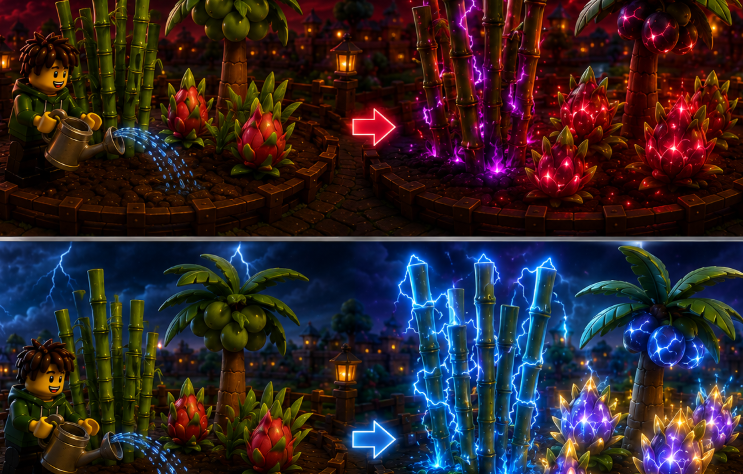
Transitioning from early to mid-game in Grow A Garden 2 requires a shift from random planting to structured farming efficiency. Players who continue using scattered layouts often experience slow income scaling and inefficient water usage. To overcome this bottleneck, crop clustering becomes essential, focusing on Bamboo, Coconut, and Dragon Fruit as the core progression trio. Using optimized Grow a Garden 2 Items enhances overall farming stability and allows smoother transition into high-yield cycles while preparing for advanced mutation systems and automated sprinkler synergy.
The mid-game system revolves around grid-based optimization where each crop plays a defined role. Bamboo serves as structural filler and fast-cycle buffer, Coconut acts as medium-value scaling crop, and Dragon Fruit functions as the high-risk, high-reward mutation engine. When combined properly, these crops form a self-sustaining farming loop. Players can further enhance efficiency by integrating pets, and advanced players often choose to buy Grow a Garden 2 Pets to increase passive bonuses such as growth speed and mutation chance.
Crop Combination Breakdown
Bamboo + Coconut
Primary Tool: Basic Sprinkler
Target Mutation Trigger: Accelerated Structural Clustering
This combination is designed for stable mid-game scaling and efficient land utilization in Grow A Garden 2. Bamboo acts as a low-cost, fast-cycle crop that continuously generates consistent returns, while Coconut provides mid-tier value stability and smoother progression flow. When supported by the Basic Sprinkler system, this setup ensures constant hydration coverage and reduces idle crop time. The goal of this pairing is not explosive profit, but reliable economic acceleration that keeps your farming loop active and efficient. Using optimized Grow a Garden 2 Items can further improve watering efficiency and field consistency during this phase.
Dragon Fruit
Primary Tool: High-Tier Can
Target Mutation Trigger: Weather-Induced Giant Mutation
Dragon Fruit functions as the high-risk, high-reward core of your mid-game farming strategy. It has significantly higher mutation volatility compared to other crops, making it ideal for triggering rare and high-value transformations. The High-Tier Can should be actively used on clustered Dragon Fruit zones to increase growth speed and mutation probability. During weather-based events, especially storms or enhanced environmental conditions, this crop can produce giant mutation variants that drastically increase profit output. For players aiming to accelerate progression, combining optimized layouts with Grow a Garden 2 Items and even choosing to buy
Bamboo Outer Ring Strategy
Bamboo should be planted along the outer ring of farming zones. Its fast growth rate and low cost make it ideal for space efficiency and buffer creation. This layer ensures constant harvest turnover and reduces empty soil downtime. It also stabilizes sprinkler coverage, allowing inner crops to receive consistent hydration support.
Coconut and Dragon Fruit Core System
Coconut and Dragon Fruit should occupy central grid positions where sprinkler and watering coverage overlap. Coconut provides stable mid-tier returns, while Dragon Fruit drives exponential mutation spikes under optimal conditions. When paired with Grow a Garden 2 Items, especially upgraded watering tools, mutation consistency increases significantly. This core design is essential for scaling into late mid-game economies.
Active Synergy and Optimization
Players should combine manual watering with automated sprinklers to maximize hydration stacking effects. This technique accelerates growth ticks and increases mutation roll frequency during weather events. Pets also play a major role in long-term efficiency, and many players choose to buy Grow a Garden 2 Pets to strengthen passive farming boosts. When combined with optimized layouts and item upgrades, the farming grid becomes a highly efficient production engine capable of sustaining rapid progression.
Proper crop clustering in Grow A Garden 2 transforms mid-game farming into a scalable system rather than random planting. With the right structure, tools, and pets, players can steadily transition into high-efficiency late-game production.