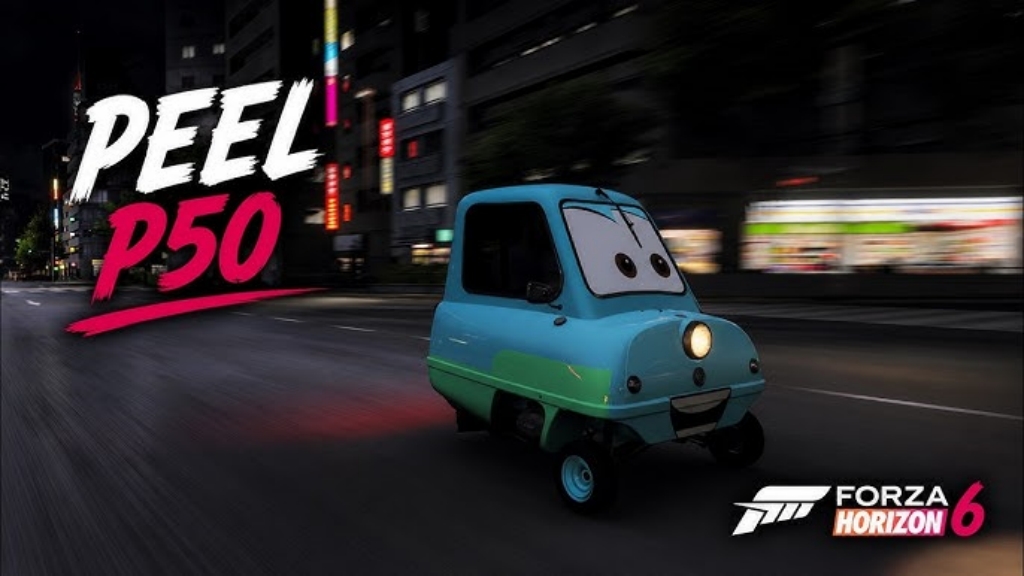
In Forza Horizon 6, one of the most absurd community experiments to emerge so far revolves around an intentionally “unbalanced” event: running bone-stock Peel P50s through both sprint and ultra-endurance races.
What starts as a joke about “the slowest car in the game” quickly turns into a structured stress test of game mechanics, player endurance, and long-distance pacing—culminating in a 53.1-mile Goliath run that pushes both players and systems to their limits.
The Core Setup: Why the Peel P50?
The Peel P50 is effectively a microcar novelty choice—minimal power, low top speed, and almost no acceleration curve worth optimizing. In this experiment, every player uses a completely stock configuration, removing tuning advantages entirely.
Key constraints:
- No upgrades
- Manual or assisted shifting allowed
- Mixed driving assists (traction control debates included)
- Long-form endurance race (Goliath equivalent)
Sprint Benchmark: Quarter-Mile Drag Test
Before the endurance chaos, players ran a baseline sprint test to understand how the P50 behaves under controlled conditions.
Drag Race Results (Estimated)
| Metric | Result |
| Distance | 0.25 miles |
| Average completion time | ~36–37 seconds |
| Top speed observed | ~29–45 mph (draft-dependent) |
| Stability control impact | Negligible / inconsistent |
| Winner variance | <2 seconds |
Despite expectations, results clustered tightly, showing that randomness (drafting, shifting timing, minor collisions) mattered more than skill ceilings.
The Main Event: 53.1-Mile Goliath Endurance Run
The centerpiece of the experiment was a full-length Goliath-style race across mixed terrain, elevation changes, and dense traffic simulation.
Race Characteristics
| Attribute | Value |
| Total distance | 53.1 miles |
| Estimated completion time | ~90–95 minutes |
| Avg progress rate | ~1% per minute |
| Max sustained speed | ~44 mph |
| Lowest sustained speed (inclines) | ~16–20 mph |
| Terrain type | Urban + mountain + snow transition |
| Assist limitations | Auto-drive disabled mid-race |
The most surprising outcome wasn’t speed—it was consistency. Even with extreme variance in driving skill and constant distractions, the group maintained a surprisingly stable progression curve.
Race Phases Breakdown
The run naturally split into distinct phases:
| Phase | Terrain | Key Challenge | Dominant Issue |
| Phase 1 | Urban circuit | Dense traffic, drafting chaos | Collision clustering |
| Phase 2 | Hills | Power starvation on inclines | Gear selection debates |
| Phase 3 | Snow transition | Low traction, visibility issues | Steering instability |
| Phase 4 | Mountain climb | Sustained low-speed grind | Physical player fatigue |
| Phase 5 | Final descent | High concentration + fatigue errors | Missed checkpoints |
Mechanical Observations
1. Gear Selection Becomes Strategy
Unlike typical racing, shifting behavior effectively became a tactical system:
- Second gear favored for torque stability
- Third gear used for downhill momentum retention
- Over-shifting consistently reduced overall speed
2. Drafting Is Minimal but Psychological
At ~30–40 mph caps, drafting provided negligible mechanical gain but strong psychological pacing cues.
3. Assists vs Reality Gap
- Traction control debates had no measurable benefit in this class
- Auto-drive was disabled due to race restrictions
- Controller fatigue became a primary limiting factor
Endurance vs Real-World Comparisons
The event unintentionally created useful pacing benchmarks:
| Activity | Duration | Relative Effort |
| Olympic marathon | ~2 hours | Higher physical intensity |
| FH6 Goliath P50 run | ~1.5 hours | Higher cognitive fatigue |
| Competitive cycling stage | 3–6 hours | Higher sustained output |
| This experiment | 90–95 minutes | High focus + low speed stress |
Interestingly, while physically trivial, the mental fatigue curve resembled longer endurance events due to constant micro-decisions.
In-Game Economy Perspective
Extended events like this raise an important gameplay question: is time investment aligned with reward output?
| Activity Type | Time Investment | Reward Efficiency |
| Standard race | Low | High |
| Goliath endurance (P50 run) | Very high | Low–moderate |
| Skill farming events | Medium | High |
This is where players often shift toward optimizing progression using FH6 Credits systems or targeted reward loops rather than novelty endurance runs.
For players who prefer progression efficiency over novelty runs, systems involving buy Forza Horizon 6 Cars or reward optimization strategies become more relevant than raw endurance grinding.
Strategic Takeaways
The Peel P50 Goliath run demonstrates several broader design truths about Forza Horizon 6:
- Low-performance vehicles amplify track design flaws and strengths equally
- Long-distance events expose UI fatigue and assist system limitations
- Player coordination matters more than vehicle stats in extreme low-speed scenarios
- Psychological pacing becomes a hidden mechanic
Most importantly, the experiment shows that even “slowest possible”builds can still produce meaningful competitive structure when scaled over extreme distances.